


TPO Commercial Roofing in San Diego: A Performance & Cost Case Study (2026)

Updated: Aug 19
What if your building's roof could actually pay for itself by slashing your cooling costs by up to 30%? For many San Diego property owners, the constant battle against rising SDG&E bills and the frustration of patching old, leaky torch-down roofs feels like a losing game. It's stressful to keep up with California's 2026 Title 24 requirements while your monthly expenses continue to climb. Choosing tpo commercial roofing isn't just about replacing a surface. It's about installing a high-performance energy asset designed to thrive in our unique coastal climate.
We understand that you want a secure, leak-free building for the next two decades without the headache of constant maintenance. This case study will show you why TPO has become the industry benchmark for durability and thermal efficiency. We'll break down the real-world performance of these "cool roofs," explain how to navigate local rebates, and demonstrate how our meticulous seam-welding process ensures your investment remains watertight and compliant for years to come.
Table of Contents
The Evolution of San Diego Commercial Roofing: Why TPO Dominates in 2026
TPO vs. Rolled Asphalt: Which Flat Roof System Wins for Your Business?
From Inspection to Protection: A Step-by-Step TPO Installation Case Study
Maximizing ROI: Energy Efficiency and San Diego 'Cool Roof' Incentives
Securing Your Investment: Why Higher Levels Roofing is San Diego’s TPO Specialist
The Evolution of San Diego Commercial Roofing: Why TPO Dominates in 2026
The San Diego skyline is undergoing a bright transformation. If you look down from a flight into San Diego International, you'll see a growing sea of white rooftops replacing the dark, heat-absorbing surfaces of the past. This shift isn't just an aesthetic choice; it's a calculated response to our region's intense solar exposure. Traditional asphalt roofs, while historically popular, struggle under the relentless Southern California sun. They absorb heat, bake the building below, and eventually crack under UV stress. This is why tpo commercial roofing has emerged as the gold standard for modern property owners who value long-term security.
At its core, Thermoplastic Polyolefin (TPO) is a single-ply, heat-reflective roofing membrane. It combines the long-term durability of rubber with the high-performance security of hot-air welded seams. For local business owners, this means a roof that doesn't just sit there. It actively works to repel heat. By reflecting a vast majority of the sun's energy back into the atmosphere, TPO prevents the thermal degradation that typically destroys older flat roof systems over time.
San Diego Microclimates and TPO Performance
Carlos and our team have spent years observing how San Diego's diverse microclimates impact roofing longevity. In coastal communities like La Jolla or Carlsbad, the primary enemy is constant salt air and high humidity. TPO is naturally resistant to the salt-induced corrosion that can plague metal components or degrade organic asphalt materials. Move inland toward San Marcos or Escondido, and the challenge shifts to extreme dry heat. TPO remains highly flexible during the significant temperature swings we see between a hot afternoon and a cool Pacific night. This flexibility prevents the membrane from becoming brittle; it ensures the system stays watertight as the building expands and contracts throughout the seasons.
Meeting California Title 24 Standards
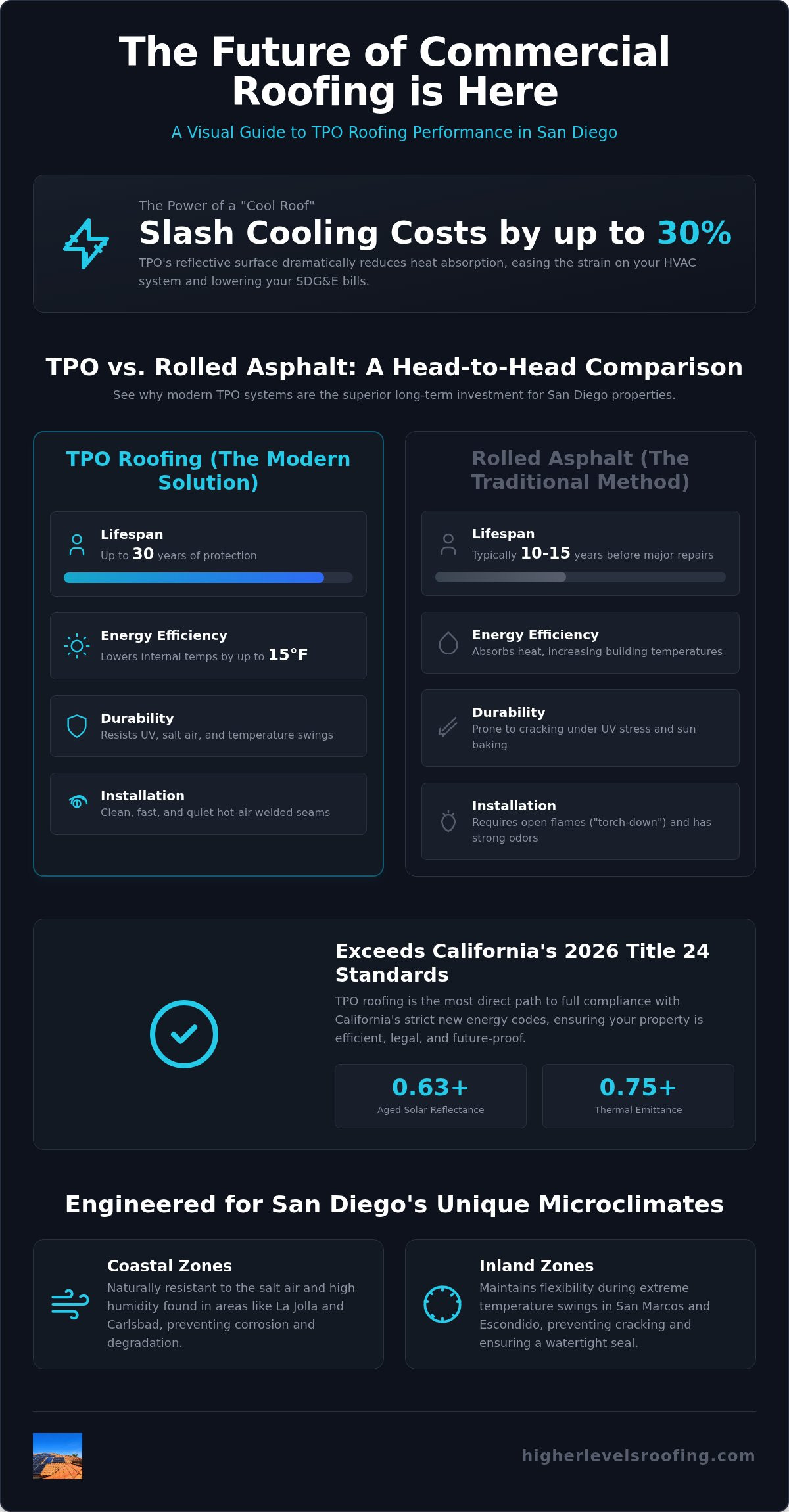
Staying ahead of state regulations is a major priority for any San Diego building manager. The 2025 version of the Building Energy Efficiency Standards became effective on January 1, 2026, and it has raised the bar for energy performance across the board. TPO's high Solar Reflectance Index (SRI) makes it the most straightforward path to compliance. It meets the rigorous thermal emittance and reflectance values required by the state without needing additional coatings or expensive modifications. For San Diego commercial roofs in 2026, Title 24 compliance requires a minimum 3-year aged solar reflectance of 0.63 and a thermal emittance of 0.75. This ensures your building stays cooler and your utility bills stay lower from the very first day of installation.
TPO vs. Rolled Asphalt: Which Flat Roof System Wins for Your Business?
Many San Diego buildings still rely on traditional rolled asphalt torch-down systems. While these were once the industry standard, tpo commercial roofing has fundamentally changed the value proposition for local businesses. The most immediate difference is longevity. A well-maintained rolled asphalt roof typically lasts 10 to 15 years before the sun-baked bitumen begins to crack and leak. In contrast, a TPO membrane often provides 20 to 30 years of service. This double lifespan significantly reduces the lifetime cost of ownership, making it a smarter long-term investment for property owners who want to avoid frequent replacements.
Beyond durability, the energy profile of these materials couldn't be more different. Asphalt is a heat magnet; it absorbs solar radiation and transfers it directly into your workspace. TPO is a "cool roof" by design. Its white surface reflects solar energy, which can lower internal building temperatures by up to 15 degrees. This shift directly impacts your bottom line by reducing HVAC strain and lowering monthly utility bills. When you consider TPO roofing installation standards, the precision of hot-air welded seams creates a monolithic barrier that asphalt simply can't match.
Speed of installation is another critical factor for active businesses. Rolled asphalt requires open flames and carries a distinct, heavy odor that can disrupt daily operations. The installation of tpo commercial roofing is cleaner, quieter, and generally faster. Because the seams are fused using specialized heat-welding equipment rather than messy adhesives or dangerous torches, the process is safer for your property and less intrusive for your tenants or employees.
The Cost-Benefit Analysis Over 20 Years
While the initial outlay for TPO might be higher than a basic asphalt patch, the ROI becomes clear when you look at the 20-year horizon. You're avoiding a full roof replacement midway through that period. Many San Diego property owners also find that upgrading to a Class A fire-rated TPO system can lead to more favorable commercial insurance premiums. For high-occupancy buildings, the combination of fire safety and leak prevention offers a level of professional assurance that asphalt can't provide. If you're weighing these options for your property, Carlos and the Higher Levels team can provide a localized performance comparison tailored to your building's history.
Aesthetic and Structural Considerations
Structural load is a common concern for older commercial structures in neighborhoods like North Park or Hillcrest. TPO is incredibly lightweight compared to multi-layered asphalt systems, putting less stress on your building's frame. While white is the most popular choice for energy efficiency, gray and tan membranes are also available to better suit specific urban aesthetics. For properties that feature a mix of flat and pitched sections, it's helpful to understand how different materials work together. You can learn more about these combinations in The Ultimate Guide to Roof Tiles. This versatility ensures your building looks as good as it performs while staying fully compliant with local codes.
From Inspection to Protection: A Step-by-Step TPO Installation Case Study
A successful installation begins long before the first roll of membrane arrives at your property. At Higher Levels Roofing, we start every project with a meticulous site assessment that goes beyond a simple surface check. Carlos personally oversees these inspections to identify structural weaknesses that generic contractors often miss. We look for signs of deck fatigue and, crucially for our region, San Diego termite damage in the wooden roof deck. Catching these issues early prevents the "hidden costs" that often plague commercial renovations.
Once the project begins, we remove the existing asphalt layers to expose the clean substrate. We don't believe in "roof-overs" that trap moisture and heat. After the deck is prepped, we install high-density insulation and a protective cover board. This layer is vital for maximizing your building's R-value, ensuring that your investment aligns with the latest standards for Energy Efficiency and San Diego 'Cool Roof' Incentives. By creating a flat, stable surface, we ensure the tpo commercial roofing membrane can be applied with surgical precision.
The Welding Process: Why Craftsmanship Matters
The true strength of a TPO system lies in its seams. While some installers rely on adhesives that can fail under San Diego's intense UV exposure, we use hot-air welding to fuse the material at over 800 degrees Fahrenheit. This process creates a monolithic bond that is actually stronger than the membrane itself. For larger projects, our team utilizes a high-speed robotic welder that maintains a constant speed and precise temperature to fuse the seams of a 10,000 sq ft San Diego warehouse into a single, impenetrable sheet. This mechanical consistency eliminates the risk of human error on long straightaways, providing a level of security that glue simply cannot match.
Flashing and Penetrations: The Leak-Proof Secret
Most commercial roof failures don't happen in the middle of the field; they happen at the edges and around equipment. HVAC units, vents, and skylights are the primary culprits for water intrusion. Instead of using generic, off-the-shelf plastic boots, we custom-fabricate TPO flashings for every penetration on your roof. This tailored approach ensures a perfect fit regardless of the equipment's age or shape. Before we consider the job finished, we walk the entire surface with our Higher Levels Roofing 50-point commercial checklist. We pressure-test every hand-welded corner and detail to guarantee your tpo commercial roofing system is ready to withstand the next twenty years of Pacific storms.
Maximizing ROI: Energy Efficiency and San Diego 'Cool Roof' Incentives
Installing tpo commercial roofing is one of the most effective ways to transform a building's financial performance. In the high-heat corridors of Carlsbad and Encinitas, a white membrane acts as a powerful thermal shield. By reflecting up to 80% of solar radiation, these systems can lower internal building temperatures by as much as 15 degrees. This temperature drop isn't just about comfort; it's about shifting the load away from your HVAC systems. When your air conditioning doesn't have to work as hard to combat radiant heat—especially when paired with other thermal solutions like window tinting San Diego—your monthly utility bills reflect that efficiency immediately.
Property owners also see a significant boost in appraisal value. In 2026, energy efficiency is a top priority for commercial buyers and investors. A building that already meets the latest Title 24 standards is much more attractive on the market. It represents a "future-proofed" asset with lower operating costs and fewer looming maintenance requirements. This makes TPO a strategic choice for anyone looking to maximize their building's resale potential in a competitive landscape.
The SDG&E Energy Impact
San Diego Gas & Electric (SDG&E) utilizes "Peak Demand" pricing, where electricity costs spike during the hottest parts of the day. A passive cooling solution like TPO helps you avoid these expensive surcharges by keeping the building naturally cooler when rates are highest. For example, some retail centers in San Diego have reported a 20% drop in cooling energy demand after converting from dark asphalt to a reflective TPO system. This matches broader industry data suggesting that high-performance cool roofs can help reduce future climate control costs by up to 30%. If you own a mixed-use property or are looking to protect your home as well, you might find our guide on How to Choose a Shingle Roofing Company helpful for your residential needs.
Navigating the financial incentives available in 2026 makes the transition even more affordable. Utility programs often provide rebates ranging from $0.20 to $0.40 per square foot for qualifying cool roof installations. Additionally, federal tax credits under the Inflation Reduction Act allow for significant deductions on energy-efficient upgrades. When you combine these rebates with the long-term energy savings, the system often pays for itself well before the end of its lifespan.
Sustainability and the San Diego Environment
Reducing the 'Urban Heat Island' effect is vital for densely developed areas like downtown San Diego and Mission Valley. When thousands of square feet of dark roofing are replaced with reflective surfaces, the ambient temperature of the entire neighborhood can drop. TPO is also a highly sustainable choice because the membranes are fully recyclable at the end of their 30-year lifecycle. This prevents thousands of tons of roofing waste from entering our local landfills. By choosing a reflective TPO system, San Diego property owners help preserve the delicate balance of our coastal ecosystem by reducing the local thermal footprint and lowering the demand for energy production.
Ready to see how much your building could save? Contact Higher Levels Roofing today for a customized energy efficiency audit of your commercial property.
Securing Your Investment: Why Higher Levels Roofing is San Diego’s TPO Specialist
Selecting the right partner for your tpo commercial roofing project is just as critical as the material choice itself. While national firms might offer flashy brochures, they often lack a nuanced understanding of San Diego’s microclimates. Carlos leads every project at Higher Levels Roofing with a commitment to meticulous craftsmanship that only a local owner can provide. We don't just see your building as a job site; we view it as a vital part of our community. This neighborly approach ensures that every weld and every flashing is handled with the same care we would use for our own properties.
Our commitment to your building continues long after the initial installation. We've developed a specialized "Salt & UV" inspection program designed specifically for our coastal environment. The intense Southern California sun can accelerate the aging of even the highest-quality membranes if they aren't monitored closely. By scheduling semi-annual check-ups, we catch minor issues before they become catastrophic failures. This proactive strategy is the best way to ensure your roof reaches its full 30-year potential.
The Local Advantage: Neighborly Service, Expert Results
Out-of-state firms often struggle with responsiveness when the rare but intense San Diego rainstorms hit. We're based right here, allowing us to be on-site quickly when you need us most. Transparency in bidding is another cornerstone of our service. You won't find hidden fees for tear-offs or structural repairs buried in the fine print. We provide a clear, honest roadmap for your roof's future, ensuring you feel in control of your maintenance budget from start to finish.
Your 2026 TPO Maintenance Checklist
Maintaining a tpo commercial roofing system in 2026 requires a focused, proactive mindset. We recommend following this simple checklist to keep your system in peak condition:
Clear drains and scuppers: Even a small amount of "ponding" water can lead to structural strain during the winter rainy season.
Inspect seams for UV fatigue: Our high-UV environment demands regular check-ups of welded joints to ensure they remain monolithic.
Prompt puncture repair: Whether from HVAC technicians or storm debris, small holes must be sealed immediately to prevent substrate damage.
We also believe in total warranty transparency. It's vital to distinguish between manufacturer material warranties and our own workmanship guarantees. While a manufacturer's warranty covers the membrane itself, it won't protect you if the installation was flawed. That's why we back our labor with a dedicated promise of quality. We stand by every weld we make. Ready to secure your building's future? Schedule a comprehensive TPO evaluation with Carlos and the team today to ensure your property is protected for decades to come.
Protect Your Building's Future with Local Expertise
Choosing the right roof for your property is a decision that impacts your bottom line for decades. We've explored how tpo commercial roofing serves as a powerful tool for energy efficiency, helping you stay compliant with 2026 Title 24 standards while slashing HVAC costs. From the salt air of La Jolla to the inland heat of San Marcos, the success of your installation depends on a meticulous seam-welding process that generic contractors often overlook. As licensed and insured San Diego specialists and Title 24 compliance experts, we take pride in delivering results that stand up to our unique coastal climate.
Don't let rising energy costs or recurring leaks compromise your investment. Our team is ready to help you navigate local rebates and design a system that provides peace of mind for the next 30 years. You deserve a roof that is as resilient as it is efficient. Take the first step toward a cooler, more secure building today. We look forward to helping you protect your property with the craftsmanship it deserves.
Request Your Free San Diego Commercial TPO Estimate
Frequently Asked Questions
How much does a TPO commercial roof cost in San Diego in 2026?
The total investment for a TPO system depends on several variables, including the thickness of the membrane and the complexity of your roof's layout. Factors like the number of HVAC penetrations, the type of insulation required for Title 24 compliance, and whether your project involves a full tear-off will influence the final cost. It's best to have a local expert conduct a site assessment to provide an accurate estimate based on your building's specific structural requirements.
How long does a TPO roof installation take for a typical commercial building?
Most commercial installations are completed within one to two weeks. This timeline can shift depending on the total square footage and the condition of the underlying roof deck. If we discover issues like termite damage or dry rot during the preparation phase, we take the necessary time to repair the substrate correctly. We prioritize a steady, methodical pace to ensure every heat-welded seam is fused perfectly rather than rushing to finish.
Is TPO roofing better than EPDM or PVC for Southern California?
TPO is often the preferred choice for San Diego because it offers exceptional UV resistance and high solar reflectance at a balanced price point. EPDM is typically black and absorbs excessive heat, which isn't ideal for our sunny climate. PVC provides similar "cool roof" benefits but often comes with a higher material cost. For most tpo commercial roofing projects, the durability and energy efficiency of TPO make it the most practical long-term solution.
Can you install TPO over an existing flat roof to save money?
A "roof-over" is sometimes possible if your building only has one existing roof layer and the substrate is dry and structurally sound. However, we generally recommend a full tear-off to inspect the deck for hidden damage and to install modern insulation that meets 2026 energy codes. Starting with a clean surface ensures your new membrane won't trap moisture, which is the most common cause of premature roof failure.
What is the life expectancy of a TPO roof in San Diego's coastal climate?
A professionally installed TPO roof typically has a service life of 20 to 30 years. In coastal neighborhoods, TPO's resistance to salt-induced corrosion gives it a distinct advantage over metal or traditional asphalt systems. To reach the maximum lifespan, we recommend choosing a thicker 60-mil or 80-mil membrane and sticking to a semi-annual maintenance schedule to keep drains clear and inspect seams for any signs of fatigue.
Does a white TPO roof really lower my building's energy bills?
Yes, the reflective properties of a white membrane can reduce your cooling energy demand by 10% to 15%. By reflecting a vast majority of solar radiation, the roof surface stays significantly cooler than dark asphalt. This keeps your building's interior temperature more stable and prevents your HVAC units from working overtime during peak afternoon heat, which directly lowers your monthly utility expenses and reduces equipment wear.
Are there tax credits available for TPO roofing in San Diego County?
Federal tax credits for energy-efficient commercial roofing have been extended through 2032 under the Inflation Reduction Act. Additionally, local property owners may qualify for SDG&E rebates, which often range from $0.20 to $0.40 per square foot for high-performance cool roofs. These incentives make tpo commercial roofing a financially savvy upgrade that helps offset the initial installation costs while ensuring your property remains fully compliant with California's energy standards.
What should I look for in a San Diego commercial TPO roofing contractor?
You should prioritize a licensed contractor who has specific expertise in Title 24 compliance and robotic seam welding. It's important to choose a local specialist who understands how San Diego's microclimates, from coastal salt air to inland heat, affect material performance. Ask about their quality control process and ensure they offer a workmanship guarantee that is separate from the manufacturer's material warranty for total protection.


Comments